
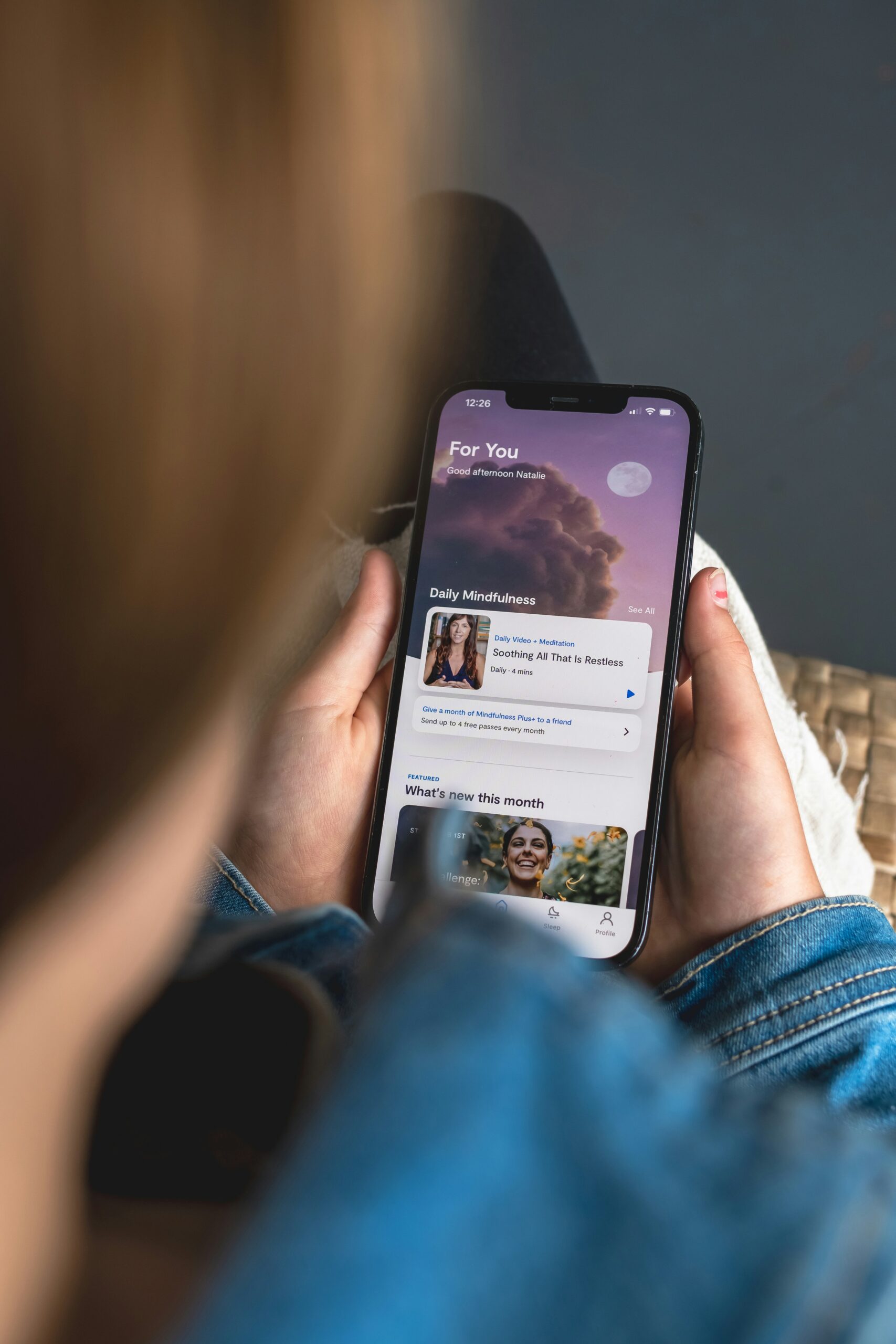
Headspace, Calm, & the Space Between Self-Care & Treatment
Series: “Screen Time vs. Session Time” (Part 2 of 2)
Companion piece: “Can an App Replace Your Therapist? What Companion AI Actually Offers” (Part 1)
In [Part 1 of this series], we looked at companion AI apps and why they can’t stand in for therapy. Mindfulness apps like Headspace and Calm are a different animal entirely, and a much less controversial one. But “different” doesn’t mean “unlimited.” Here’s where they genuinely help, and where the line still is.
What the evidence actually supports
Meditation and mindfulness-based apps have a reasonable evidence base for mild-to-moderate stress, sleep difficulty, and general anxiety symptoms, not as a cure, but as a structured way to build a skill (attention regulation, physiological down-regulation) that has measurable downstream effects. This isn’t the same as saying they treat clinical anxiety disorders, major depression, PTSD, or any condition where symptoms are significantly impairing function. For those, they’re a reasonable adjunct to treatment, not a substitute for it.
The distinction that matters clinically: mindfulness apps deliver structured, evidence-informed content on a fixed program. They’re not responsive to you the way a companion AI is, and that’s actually a strength here. There’s no unpredictable output, no risk of the app improvising something harmful in response to a disclosure. The tradeoff is that they also can’t recognize when your symptoms have moved outside what a breathing exercise can touch.
Where marketing gets ahead of the evidence
Worth naming directly: some of these apps have, at various points, leaned on messaging that blurs self-care and treatment, implying a level of therapeutic benefit the underlying research doesn’t fully support for anything beyond mild symptoms. That’s a marketing problem, not necessarily a product problem. The tools themselves are fine for what they actually do. The issue is when “10 minutes of Headspace” gets treated as equivalent to addressing a mood or anxiety disorder that’s actually impairing your life.
The useful framework
Think of it as three tiers:
- Maintenance — you’re doing fine, and a meditation app helps you stay that way. No concerns here.
- Adjunct — you’re in treatment (therapy, medication, or both) and using the app to reinforce skills between sessions. This is exactly what these apps are good for.
- Substitute — you’re using the app instead of seeking care because symptoms are worsening. This is the tier that needs a second look, for the same reason it matters with companion AI: the app has no way to notice that things have changed, and no mechanism to escalate.
The signal that matters
If a mindfulness app is helping you feel more grounded day to day, keep using it, there’s no reason not to. But if you’ve noticed you’re reaching for a 10-minute breathing exercise to manage something that’s been building for weeks or months, sleep that isn’t improving, anxiety that’s starting to interfere with work or relationships, mood that isn’t lifting. That’s the point where the app has quietly shifted from tier 2 to tier 3 without anyone deciding that on purpose.
That shift is worth noticing on its own. It’s not a failure of the app or of you, it’s just information that the level of support you need has changed.
Both pieces, one point
Companion AI and mindfulness apps sit at opposite ends of the risk spectrum: one open-ended and unpredictable, one structured and evidence-informed. But they lead to the same practical advice: use the tools that help, and let them tell you something rather than replace something. An app that reflects your stress back to you, however well-designed, still isn’t a person who knows your history and can tell when this time is different.
Missed Part 1? [Read about companion AI apps and therapy →]